HappyHorse vs Seedance 2.0: What Public Evidence Shows
HappyHorse vs Seedance 2.0: a careful comparison of leaderboard signals, access, and what remains unclear around audio and workflow fit.
HappyHorse-1.0 vs Seedance 2.0 is exactly the kind of AI video comparison people try to settle too fast.
That is easy to understand. HappyHorse showed up suddenly and landed high on public leaderboards. Seedance 2.0 was already one of the main reference points in AI video. Once those two names started appearing in the same screenshots and X threads, the comparison was going to happen.
The problem is that a lot of the current discussion mixes together three different things:
- public blind-test quality signals
- real product availability
- community claims about features that are not fully verified yet
Those are not the same thing.
So this article takes a narrower approach. I am not trying to declare a universal winner in every category. I am looking at what the current public evidence supports, where HappyHorse seems ahead, where Seedance still looks more practical, and what still remains unclear.
If you are new to HappyHorse itself, start with our explainer on What Is HappyHorse-1.0?.
The short answer
If you only want the quick version, it is this:
- HappyHorse-1.0 currently has the stronger public leaderboard signal in no-audio text-to-video and image-to-video
- Seedance 2.0 still looks easier to understand as a real product choice today, even if the leaderboard headline is weaker
- Audio, architecture, speed, and full availability are still not clear enough to support sweeping final claims
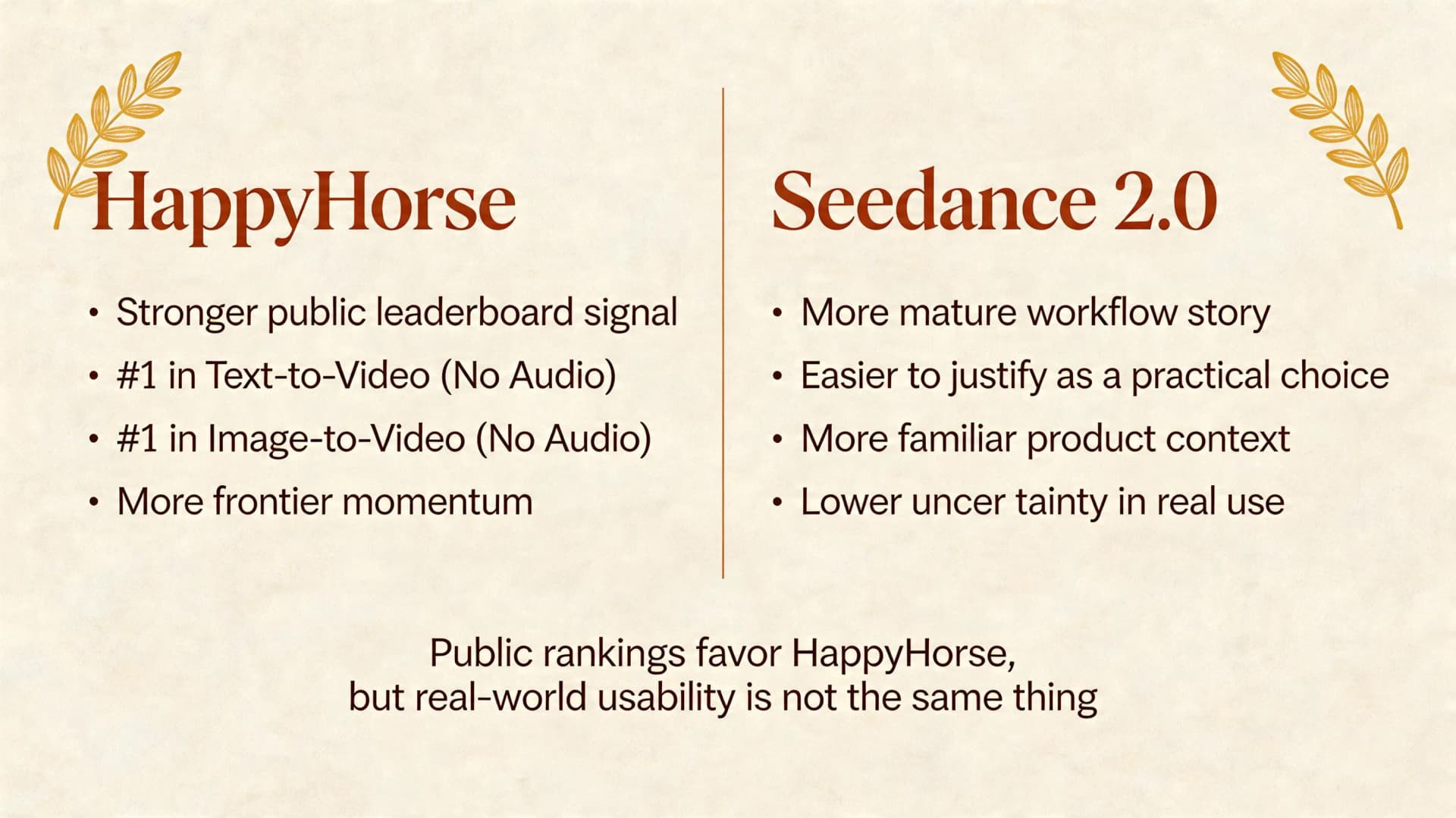
So if your question is "Which model looks stronger in public blind-vote quality right now?", the answer leans toward HappyHorse.
If your question is "Which one feels more mature as a workflow decision today?", the answer is less clear, and in some cases still leans toward Seedance.
The cleanest comparison point: public leaderboard performance
This is where the strongest current evidence exists.
On Artificial Analysis, HappyHorse-1.0 is currently ahead of Dreamina Seedance 2.0 720p in the no-audio categories:
- Text-to-Video (No Audio): HappyHorse-1.0 #1, Dreamina Seedance 2.0 720p #2
- Image-to-Video (No Audio): HappyHorse-1.0 #1, Dreamina Seedance 2.0 720p #2
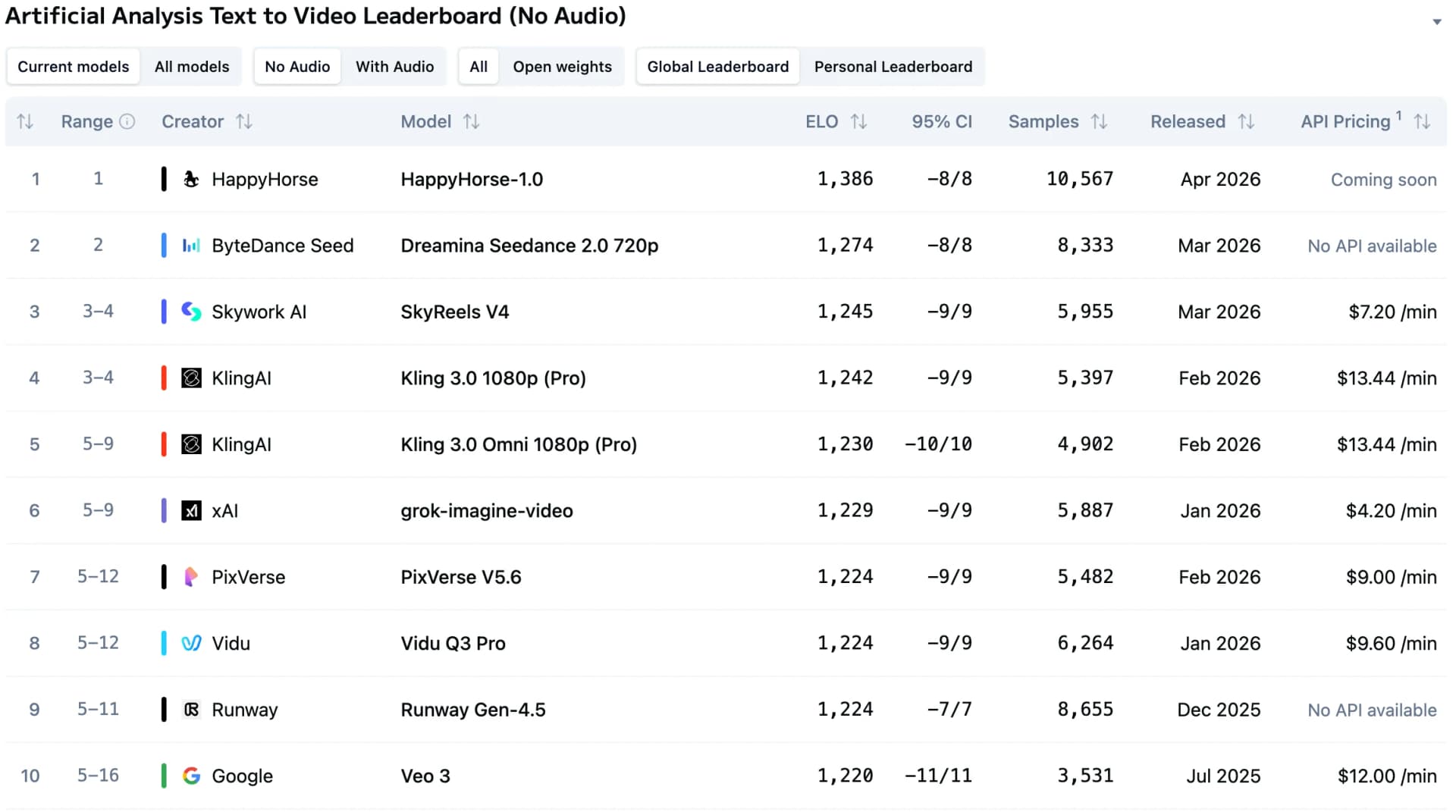
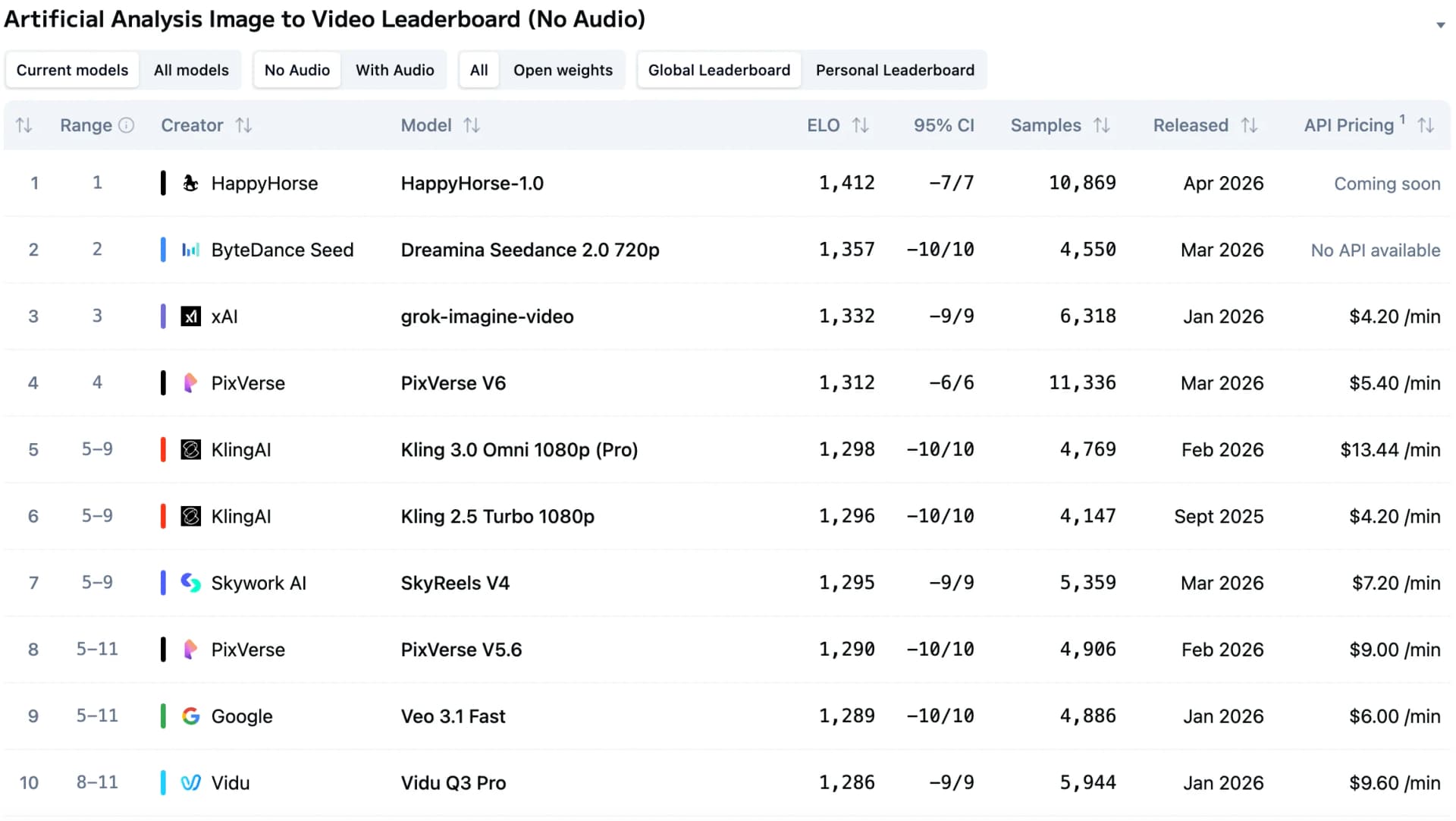
That matters because Artificial Analysis uses blind human preference voting. People compare outputs from the same prompt without knowing which model produced which video. That makes the result more meaningful than ordinary product marketing or cherry-picked demos.
This does not prove that HappyHorse is better in every real production scenario. It does support one concrete point:
On the strongest publicly visible quality benchmark we currently have, HappyHorse has the better headline position.
That is the whole reason this comparison matters right now.
Why that does not automatically make HappyHorse the better real-world choice
This is where people flatten the story too much.
A model can lead on blind preference rankings and still be harder to use in practice. In AI video, the gap between "looks strongest in public evaluation" and "is easiest to ship real work with" can be pretty large.
For most creators and teams, the practical questions are boring but decisive:
- Can I access it reliably?
- Is pricing clear?
- Are results reproducible?
- Is there enough documentation?
- Is the workflow stable enough for deadlines?
Those questions matter just as much as visual quality.
And this is exactly where HappyHorse and Seedance start to feel like very different kinds of options.
Where HappyHorse currently looks stronger
1. Public blind-vote quality signal
This is the clearest advantage.
If you care most about what anonymous users preferred in direct output comparisons, HappyHorse currently has the better scoreboard story. It arrived with immediate leaderboard impact instead of gradually climbing over time.
That gives it a level of momentum Seedance does not currently own in the same way.
2. Frontier attention
HappyHorse also feels more like the model people are watching for the next shift in AI video quality. In fast-moving categories, that matters. Even before access is settled, one model can start resetting expectations.
That seems to be what is happening here.
3. Image-to-video intrigue
A lot of the public excitement around HappyHorse is not only about text-to-video. It is also about image-to-video. That matters because for many commercial workflows, image-to-video is the more useful test.
Product stills, ad concepts, campaign visuals, character frames, and ecommerce assets all make image-to-video especially valuable. So a model that performs strongly there gets attention for good reason.
Where Seedance 2.0 still looks stronger or safer
1. Product maturity
Seedance is easier to place inside a familiar workflow conversation.
Even when public leaderboard results are not in its favor, it benefits from being a more legible part of an existing ecosystem. People have a clearer sense of what it is, where it fits, and how it compares with other already-productized AI video options.
That lowers uncertainty.
2. Practical adoption confidence
A model can be slightly weaker in public rankings and still be the safer choice for teams that care more about access, stability, and predictable operations than about chasing the newest quality headline.
This is where Seedance still has an advantage in perception, and possibly in practice too.
3. Less mystery
One of HappyHorse's strengths is that it arrived dramatically. One of its weaknesses is the same thing.
A sudden rise creates excitement, but it also creates open questions around availability, release structure, technical claims, and long-term reliability. Seedance does not benefit from novelty in the same way, but it also does not suffer from as much uncertainty.
What about audio?
This is one of the trickiest parts of the comparison.
A lot of public discussion around HappyHorse mentions audio-related capabilities, joint audio-video generation, or lip-sync. At the same time, Seedance is often discussed as a model with strong real-world video product value beyond simple leaderboard screenshots.
The problem is that current public sources are not stable enough to support a confident, final statement like:
- "HappyHorse clearly beats Seedance on audio"
- or
- "Seedance clearly beats HappyHorse on audio"
That would be too strong.
The safer conclusion is:
- audio capability is part of the HappyHorse story
- audio should matter in any real comparison
- but the public evidence is still not clean enough to turn that into a hard verdict
So if audio is your main decision factor, the current evidence should make you more cautious, not more confident.
What about speed, specs, and architecture?
This is another category where people are getting ahead of the evidence.
There are repeated public claims online about:
- exact parameter counts
- unified architecture details
- 1080p generation speeds
- multilingual lip-sync support
- open-source release plans
Some of these claims may turn out to be true. Some may already be directionally right. But the important point is that they do not all carry the same evidentiary weight as the leaderboard rankings.
That means they should not be used as the foundation of the comparison.
For now, the safest way to use these claims is as context, not conclusion.
So which model should creators care about more right now?
That depends on what kind of question you are trying to answer.
A side-by-side comparison clip showing why HappyHorse and Seedance 2.0 can appeal to different priorities, without treating one short demo as a universal verdict.
Choose HappyHorse as the more interesting signal if:
- you care most about current public quality rankings
- you want to track frontier movement early
- you are especially interested in image-to-video quality shifts
- you want to know which new model might be changing the conversation fastest
Keep Seedance higher on your shortlist if:
- you care more about current workflow confidence than leaderboard novelty
- you want less uncertainty around how to think about the model in practice
- you prefer tools with a clearer maturity story
- you are making production decisions, not just watching the frontier
That is why this comparison is not just about "who is #1 today." It is really about what kind of evidence you trust most.
The best current conclusion
Another side-by-side comparison clip that gives readers one more direct look at how HappyHorse and Seedance 2.0 can differ in output feel, without treating a single example as definitive proof.
Here is the strongest balanced conclusion the current evidence supports:
HappyHorse-1.0 currently looks stronger on public no-audio blind-vote leaderboards. Seedance 2.0 still looks easier to justify as a practical, less mysterious workflow choice.
That is not the flashy answer. It is the useful one.
Too many AI comparison posts force a final answer before the evidence is ready. This is one of those cases where a split conclusion is the honest one.
FAQ
Is HappyHorse better than Seedance 2.0?
On current public no-audio leaderboard evidence, HappyHorse has the stronger headline result. That does not automatically make it the better choice for every creator or team.
Why is HappyHorse ranked higher right now?
The strongest public reason is its current position on Artificial Analysis in blind human preference rankings for no-audio text-to-video and image-to-video.
Does Seedance still matter if HappyHorse is ranked higher?
Yes. Product maturity, workflow clarity, and practical adoption matter a lot in AI video. A leaderboard lead does not erase those advantages.
Which one is better for production use?
The public evidence does not support a universal answer yet. If you need a more stable product decision today, Seedance may still feel safer. If you are tracking the frontier of visible quality, HappyHorse is harder to ignore.
Should I switch from Seedance to HappyHorse right now?
Not based on hype alone. The smarter move is to evaluate access, pricing, reproducibility, and workflow fit, not just rankings.
Final verdict
If you reduce this comparison to a single sentence, you lose the interesting part.
HappyHorse vs Seedance 2.0 is really a comparison between:
- a model with the stronger current public quality headline
- and a model that still feels easier to place inside a real product workflow
That is why both still matter.
Right now, HappyHorse deserves the attention. Seedance still deserves the practical respect.
If your job is understanding where AI video is heading, watch HappyHorse closely. If your job is shipping dependable work today, keep your standards higher than leaderboard excitement.
Need AI video tools you can actually work with while the leaderboard keeps changing?
Follow the frontier, but build with workflows that help you ship usable video now.
Try FlashEdit AI Video Generator →Author

More Posts

What Is GPT Image 2? 5 Areas It Looks Better
GPT Image 2 has not launched officially, but early leaks point to gains in text rendering, photorealism, UI generation, and dense scene control.

Veo 3.1 Prompts: Fix What’s Making Videos Fail
Learn how to fix common Veo 3.1 prompting mistakes, think like a director, and get more coherent video results with better-matched audio.
Seedance 2.0 Brings Commercial Grade AI Video
Seedance 2.0 is trending because its outputs look like usable footage for ads, product pages, and brand posts without apologizing for artifacts.