What Is HappyHorse 1.0? What We Know So Far
What is HappyHorse 1.0? This explainer covers why it surfaced so quickly, what public evidence supports, and which claims still remain unverified.
HappyHorse-1.0 went from obscure to unavoidable very quickly.
One week it was barely in the conversation. Then it started showing up in leaderboard screenshots, X threads, and "have you seen this yet?" posts all over AI video circles. When that happens, the internet does what it always does: some people spot a real signal, and everyone else starts paraphrasing each other.
So I think the useful question is not "Is HappyHorse definitely the new king of AI video?" It is this:
What do we actually know so far, and what is still being repeated too confidently?
That is what this article is for. Not to overhype it, not to wave it away, just to separate the solid parts of the story from the blurry ones.
What is HappyHorse-1.0?
HappyHorse-1.0 is a newly surfaced AI video model that has drawn attention because of its strong showing on public video leaderboards, especially in text-to-video and image-to-video rankings.
The clearest reason people care is not just that it exists. It is that it showed up with unusually strong blind-test results.
On Artificial Analysis, HappyHorse-1.0 currently ranks:
- #1 in Text-to-Video (No Audio)
- #1 in Image-to-Video (No Audio)
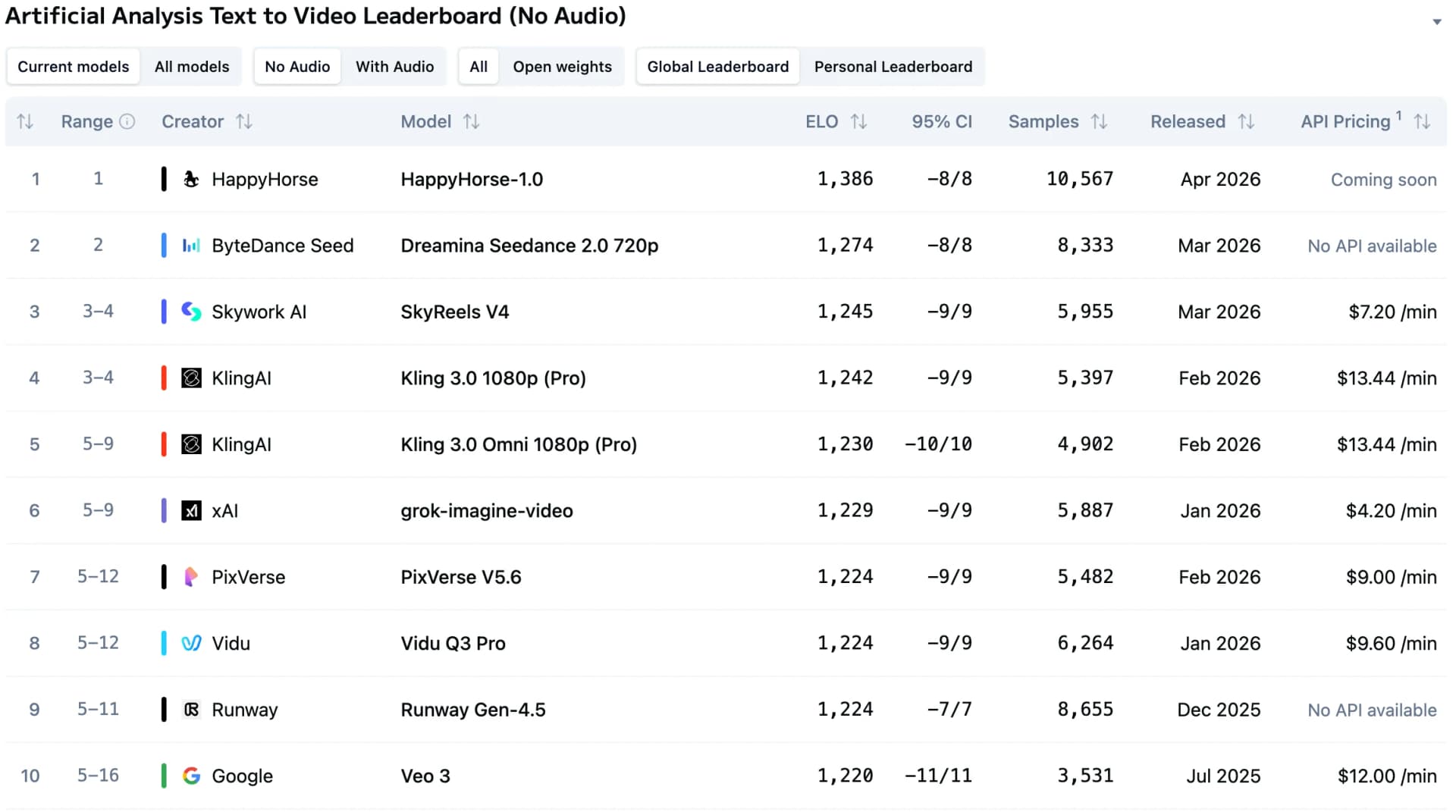
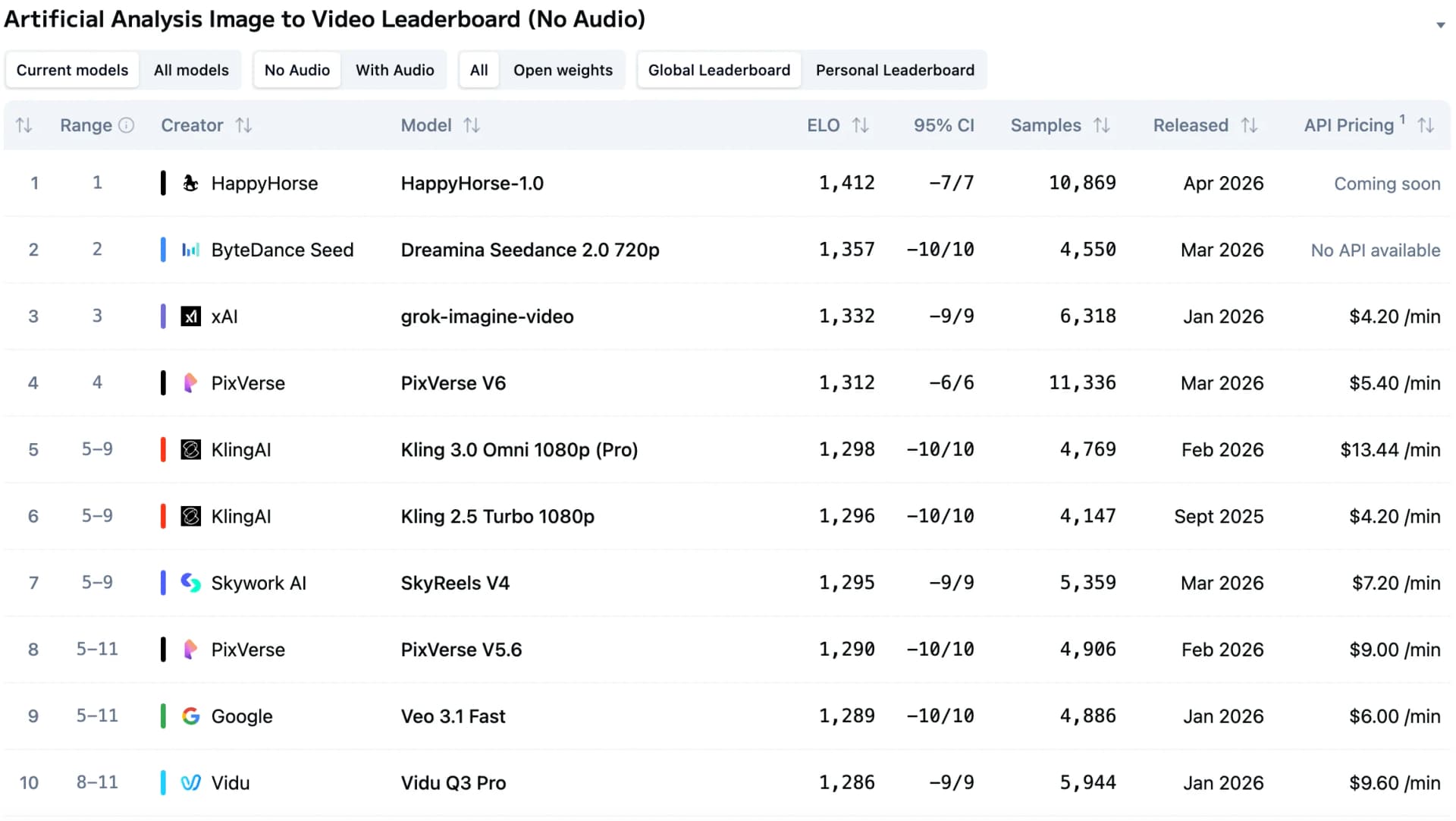
That matters more than most benchmark chatter because Artificial Analysis uses blind human preference voting, not vendor self-scoring. People compare outputs without knowing which model made them.
That still does not mean HappyHorse is automatically the best choice for real work. It does mean the model has moved past rumor status. It deserves a proper look now.
Why is HappyHorse suddenly everywhere?
Because AI video is still a category where visible jumps spread fast.
When a model lands near the top of a public leaderboard, especially one creators and tool builders already watch, people immediately ask the same questions:
- Who built it?
- Can I try it?
- Is it actually better than Seedance, Kling, or other leading models?
- Is the benchmark signal real, or just early noise?
That is what happened here.
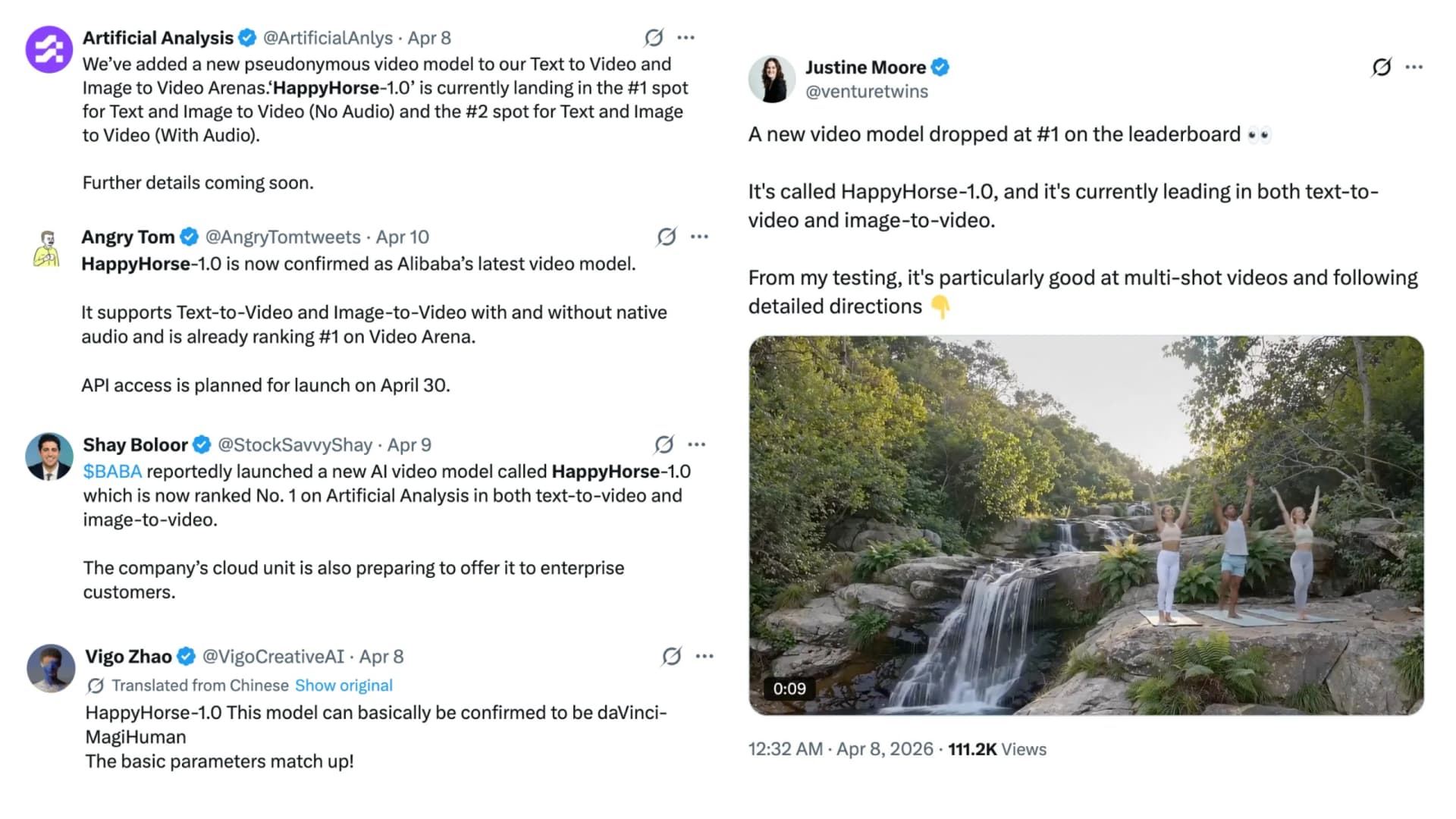
Part of the attention came from the leaderboard. Part came from the mystery around who built it. And part came from the obvious fact that AI video people are desperate for anything that looks like a real step forward in motion, coherence, or image-to-video quality.
So yes, it went from near-unknown to heavily discussed in a matter of days.
Who is behind HappyHorse-1.0?
This is one of the biggest places where the public picture became clearer.
According to a CNBC report, Alibaba confirmed that the X account identifying HappyHorse as an Alibaba project was genuine. CNBC described HappyHorse-1.0 as a model that appeared on Artificial Analysis around early April and quickly climbed to the top of blind-test rankings for both text-to-video and image-to-video generation.
So while there is still plenty we do not know about the full product and release plan, the model no longer looks like a random anonymous project with no credible owner behind it. The Alibaba connection is much stronger than a pure community rumor.
That said, ownership clarity is not the same as full technical clarity. We still need to separate:
- what is supported by independent reporting
- what is visible on leaderboard pages
- what is being claimed by model-related landing pages or partner platforms
That distinction matters a lot with HappyHorse.
What does the public evidence support right now?
This is the most important section.
A lot of pages discussing HappyHorse blur together solid evidence, weak evidence, and plain marketing. That is how shaky claims start sounding established.
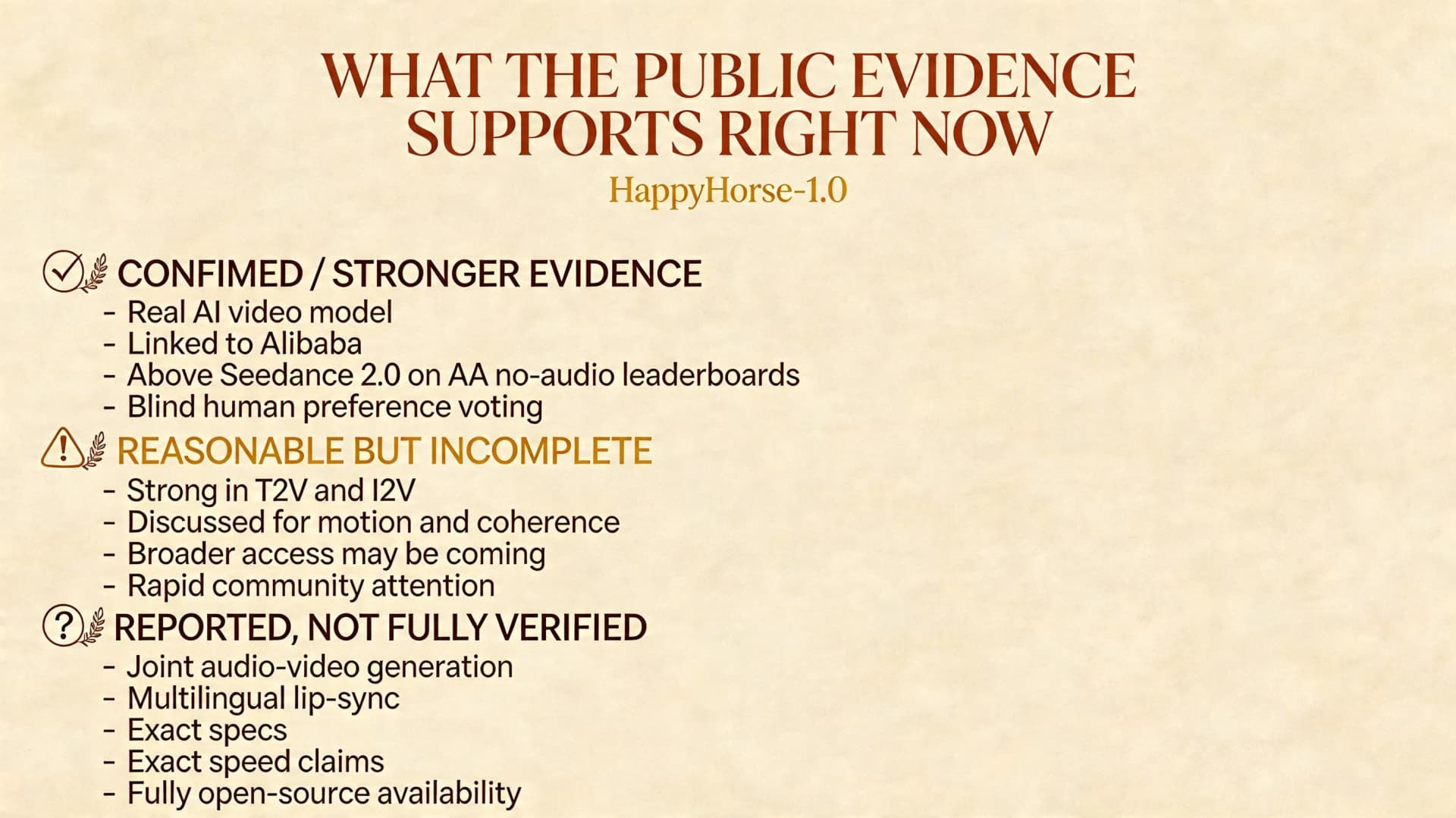
Stronger evidence
These points have the best current support:
- HappyHorse-1.0 is a real AI video model attracting serious attention
- Alibaba has been publicly tied to the project through mainstream reporting
- HappyHorse currently ranks above Dreamina Seedance 2.0 720p on Artificial Analysis in:
- Text-to-Video (No Audio)
- Image-to-Video (No Audio)
- Artificial Analysis uses a blind human preference framework, which makes those rankings more meaningful than ordinary self-published demo claims
Reasonable but still incomplete
These points appear often enough to matter, but they still need caution:
- HappyHorse is being framed as strong in both text-to-video and image-to-video workflows
- public discussion frequently presents it as especially relevant for creators who care about output quality, motion, and visual coherence
- it appears to be moving quickly toward broader platform availability, even if public access still looks limited
Reported, but not fully verified
These are the kinds of claims you should not repeat as settled facts without qualification:
- joint audio-video generation in a single pass
- multilingual lip-sync support
- exact architecture details
- exact parameter count
- exact speed claims such as specific 1080p generation times
- open-source availability in the strong, practical sense people usually mean
Some of these claims appear on third-party product pages and platform writeups, and some are repeated widely enough that they may turn out to be true. But right now, they do not all have the same evidentiary weight as the leaderboard results or the Alibaba identity reporting.
How strong is HappyHorse on public leaderboards?
This is where the strongest comparison evidence exists today.
On Artificial Analysis, HappyHorse-1.0 is currently ahead of Dreamina Seedance 2.0 720p in the no-audio categories:
- Text-to-Video (No Audio): HappyHorse #1, Dreamina Seedance 2.0 720p #2
- Image-to-Video (No Audio): HappyHorse #1, Dreamina Seedance 2.0 720p #2
That is the clearest public reason the model spread so quickly.
This does not justify turning the story into "HappyHorse beats every model in every situation." What it does justify is something narrower:
Based on current public blind-vote leaderboard evidence, HappyHorse is one of the strongest AI video models to watch right now, especially in no-audio T2V and I2V.
That is a meaningful claim, and it is one the public evidence can actually support.
What is still unclear?
Quite a lot, actually.
This is why HappyHorse is a better subject for a careful explainer than a victory-lap blog post.
1. Real-world access
A model can rank well in blind preference tests and still be hard to use in practice.
Right now, one of the biggest unresolved questions is simple: how available is HappyHorse for ordinary builders, creators, and teams?
Public pages suggest broader access is coming, but a high-ranking model is not the same thing as a stable production workflow.
2. Audio claims
Public sources often describe HappyHorse as an audio-capable or joint audio-video model. That may prove important. But the exact state of those capabilities, and how they compare in real use, still does not feel settled enough to overstate.
3. Technical specifications
There are many repeated claims online about architecture, parameter counts, and speed. Some may be directionally right. But the safest position right now is to treat those details as reported claims, not fully locked-down facts.
4. Open-source status
A lot of people use the phrase "open source" too loosely in AI.
There is a major difference between:
- a model being described as open or open-source-oriented
- a model having public weights, a usable license, deployment assets, and real self-hosting practicality
Until that is clearer, it is better not to write as if HappyHorse is already fully open in the strongest sense.
Is HappyHorse-1.0 better than Seedance 2.0?
The honest answer is: it depends on what you mean by better.
If you mean public blind-test quality in no-audio leaderboard categories, then HappyHorse currently has the stronger headline position.
If you mean practical maturity, access, and production readiness, the answer is less clear. This is exactly where leaderboard quality and real workflow quality often diverge.
That is why the fairest current comparison is:
A side-by-side comparison clip showing why HappyHorse and Seedance 2.0 are being discussed together, without treating one short demo as a final verdict.
- HappyHorse: stronger current public leaderboard signal
- Seedance 2.0: still easier to understand in the context of an existing product ecosystem and broader user familiarity
So if you are trying to understand the frontier, HappyHorse matters a lot. If you are trying to choose what to use right this second for dependable work, you still need to ask boring but important questions:
- Can I access it reliably?
- Are the outputs reproducible?
- Is pricing clear?
- Is the workflow stable?
- Is there enough documentation and user experience around it?
Those questions matter as much as raw leaderboard position.
If you want a direct side-by-side breakdown, read our HappyHorse vs Seedance 2.0 comparison rather than trying to force the whole comparison into this explainer.
Who should pay attention to HappyHorse?
AI video creators
If you actively test frontier models, HappyHorse is absolutely worth watching. The leaderboard signal is strong enough that ignoring it would be strange.
Ecommerce and product-marketing teams
If your workflows depend on turning prompts or still assets into usable video, any model that appears to raise the quality ceiling in text-to-video or image-to-video is worth tracking.
Tool builders and product teams
Even before full access is clear, the market conversation itself matters. Once users start hearing a model name repeatedly, it shapes expectations for quality, speed, and features.
Researchers and benchmark watchers
HappyHorse is also interesting because it is a reminder that strong entrants can appear quickly and shift the public leaderboard conversation faster than many teams expect.
Should you use HappyHorse right now?
Keep an eye on it. Test it if you get the chance. Just do not let hype answer practical questions for you.
Right now, HappyHorse looks like:
- a model with unusual momentum
- a model with real leaderboard support
- a model getting more attention than clarity
That is enough to make it worth following closely. It is not enough to skip due diligence.
FAQ
Is HappyHorse-1.0 real or just hype?
It is clearly real enough to matter. The strongest public evidence is its Artificial Analysis leaderboard performance and the reporting linking it to Alibaba. The hype is real too, but it is attached to something substantive.
Is HappyHorse-1.0 from Alibaba?
Mainstream reporting has linked the model to Alibaba, and CNBC reported that Alibaba confirmed the relevant identification post was genuine.
Is HappyHorse-1.0 open source?
Do not assume that yet in the strongest practical sense. Some public pages describe it that way, but "open source" in AI can mean very different things unless weights, licensing, and deployment details are all clearly available.
Is HappyHorse-1.0 better than Seedance 2.0?
On current public no-audio leaderboard results, HappyHorse has the stronger headline ranking. That is not the same as proving it is better for every real-world workflow.
Can HappyHorse generate audio too?
Many public descriptions say it can, but the safest way to phrase it today is that audio-related capabilities are reported, not something we would present as fully settled without further confirmation.
Final verdict
HappyHorse-1.0 matters because, unlike most new model names, it already has a real public case behind it.
Not just buzz. Actual reasons:
- strong blind-vote leaderboard performance
- credible reporting linking it to Alibaba
- enough discussion across the AI video world that ignoring it now would be lazy
At the same time, this is still not a finished story.
So the right takeaway is not "believe every claim." It is this:
HappyHorse-1.0 looks important enough to take seriously, but it still needs to be evaluated with a clean line between what is confirmed, what is reported, and what is still unclear.
Want a practical AI video workflow while new models keep evolving?
New models will keep coming. The real advantage is knowing how to evaluate them without getting lost in the hype.
Try FlashEdit AI Video Generator →Author

More Posts
Seedance 2.0 Brings Commercial Grade AI Video
Seedance 2.0 is trending because its outputs look like usable footage for ads, product pages, and brand posts without apologizing for artifacts.
HappyHorse vs Seedance 2.0: What Public Evidence Shows
HappyHorse vs Seedance 2.0: a careful comparison of leaderboard signals, access, and what remains unclear around audio and workflow fit.

What Is GPT Image 2? 5 Areas It Looks Better
GPT Image 2 has not launched officially, but early leaks point to gains in text rendering, photorealism, UI generation, and dense scene control.